English HOME

Brand Story      Royal Copenhagen
The founding of The Royal Privileged Porcelain Manufactory

In Meissen, J.F.Bottger discovers the secret of Chinese porcelain, and porcelain manufactories begin to spring in Europe. Even in a prosperous country like Denmark desired earnestly to be a procelain-producing country.
The chemist F.H. Muller's experiments with the manufacture of porcelain result on 1 May 1775 in the founding of the limited company 'The Royal Priviled Porcelain Manufactory', under the patronage of Queen Juliane Marie, Crown Prince Frederik and Christian Z.
This is how the Royal Copenhagen begins.

The Royal Copenhagen Porcelain Manufactory

In 1779, the klin of Royal Copenhagen was taken over financial responsibility by Christian Z and, after which the name is changed to "The Royal Copenhagen Porcelain Manufactory"

Flora Danica

The most famous dinner service of Royal Copenhagen Porcelain Manufactory is Flora Danica, which originates from 1970.
It is generally believed that the Flora Danica dinner set was intended as a present from the Danish king to the Russian Empress Catharine U, enthusiastic collector of porcelain.
The 'Flora Danica Service' was based on the botanical work on Danish flora, 'Flora Danica', and there were 2,600 kinds of flowers in their designs.
However, in 1796 when Empress Catharine U was deceased, the production was ordered to stop and the service had been reached 1802 pieces. The original Flora Danica service remain safely exhibited at Rosenborg Castle, now a museum. Of the 1,802 pieces, about 700 pieces have been produced on a commercial basis.

The Royal Copenhagen Porcelain Manufactory was privatised.

The Royal Copenhagen Porcelain Manufactory came into private hands in 1868.
In 1885 Arnold Krog was appointed artistic director of the Royal Copenhagen Porcelain Manufactory. Royal Copenhagen could build a solid fame by his magnificent work.
Each porcelain item from The Royal Copenhagen Porcelain Manufactory was marked with three waves: the Sound and the Great and Little Belts, and signed with the painter's name.


Introduction of popular series

Flora Danica

The concept of the original Flora Danica was to reproduce Danish plants on the porcelain service, and flowers on 'Flora Danica'(Danish flower book) were depicted as the patterns of this service.
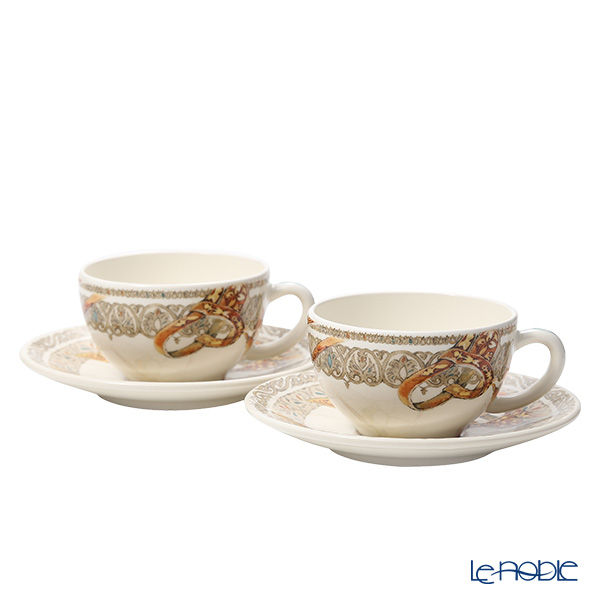
As of now, about 700 patterns are merchandised.
Based on the Danish flower book, Each Flora Danica was drawn by skilled craftman with care by hand.
As a consequence of its luxury colour and fineness, Flora Danica receives high acclaim worldwide.


Blue Fluted Full Lace

Blue fluted full lace was no.1 pattern of Arabesque and was received a hint of Chinese colouring technique.
The delicate and graceful pattern receive world fame.


A list of product lines

There are many varieties of attractive product series in Royal Copenhagen.
Here you can find a list of each product line of our selection.
Although the list is composed of Japanese only, we are working on translating into English right now. So please wait for a while, and for the time being, please enjoy the photos of our selections.


Royal Copenhagen Porcelain Manufactory Marks

--Case of Blue Fluted Half Lace Coffee Cup & Saucer--

Having a careful look at the logo, 'ROYAL COPENHAGEN DENMARK' marked around Crown, there are dots placed just above some letters. These marks indicates the date they were made of. (There are dots just above R and A for the production in 2002.)
Each porcelain has a drawing with famous three waves: It is the painter's signature.
Item numbers were painted in green by hand in former days, but it has been changed into three digits of a carved seal.
Cups:07[2], Saucer:07[3], and Model Number: 07[1]
It is a rule in common for each cup & saucer as is the case of Meissen.
(The picture on the left is Blue Fluted Half Lace coffee C/S(S)#068.)

@


Store Guide : TO A LIST OF PRODUCTS